


Why our products?
- Free shipping on orders over 49 €
- Satisfied customers
- Delivery date is specified within the product description
Not all matcha is good matcha: How to recognize quality and why it matters

In this article, we'll take a look at what exactly affects the price of matcha and how to choose one that will fulfill your expectations.
Japan or China? This should be your first question
Before you start looking at prices, you should know that matcha isn't exclusively from Japan. Nowadays, China is one of the largest producers of this fine green powder, but, it has a slightly different taste and uses.
Why does authentic Japanese matcha take so long?
Each bag of matcha equals months of work that starts long before the leaf is even picked from the plant. A few weeks before harvest, the gardens are shaded with tarps, so only a fraction of sunlight actually reaches the plants. Because of this, tea plants start to vigorously produce chlorophyll to make the most of each ray of sun.
At the same time, it concentrates more amino acids, especially L-theanine, into the leaf. This is the substance responsible for the signature umami sweetness that's always lacking in cheap matcha. And the longer the shading, the larger the benefits. After the harvest, tea leaves are steamed and dried before the stems and veins are carefully removed. Once you're left with only the pure leaf matter, it's ground into a fine powder.
The stone mill may be the most important part of the process. One traditional granite mill can only produce about 30 to 40 grams of powder per hour. Slow grinding protects the tea from being heated by friction,, which destroys the chlorophyll, amino acid, and even the aromatics content.
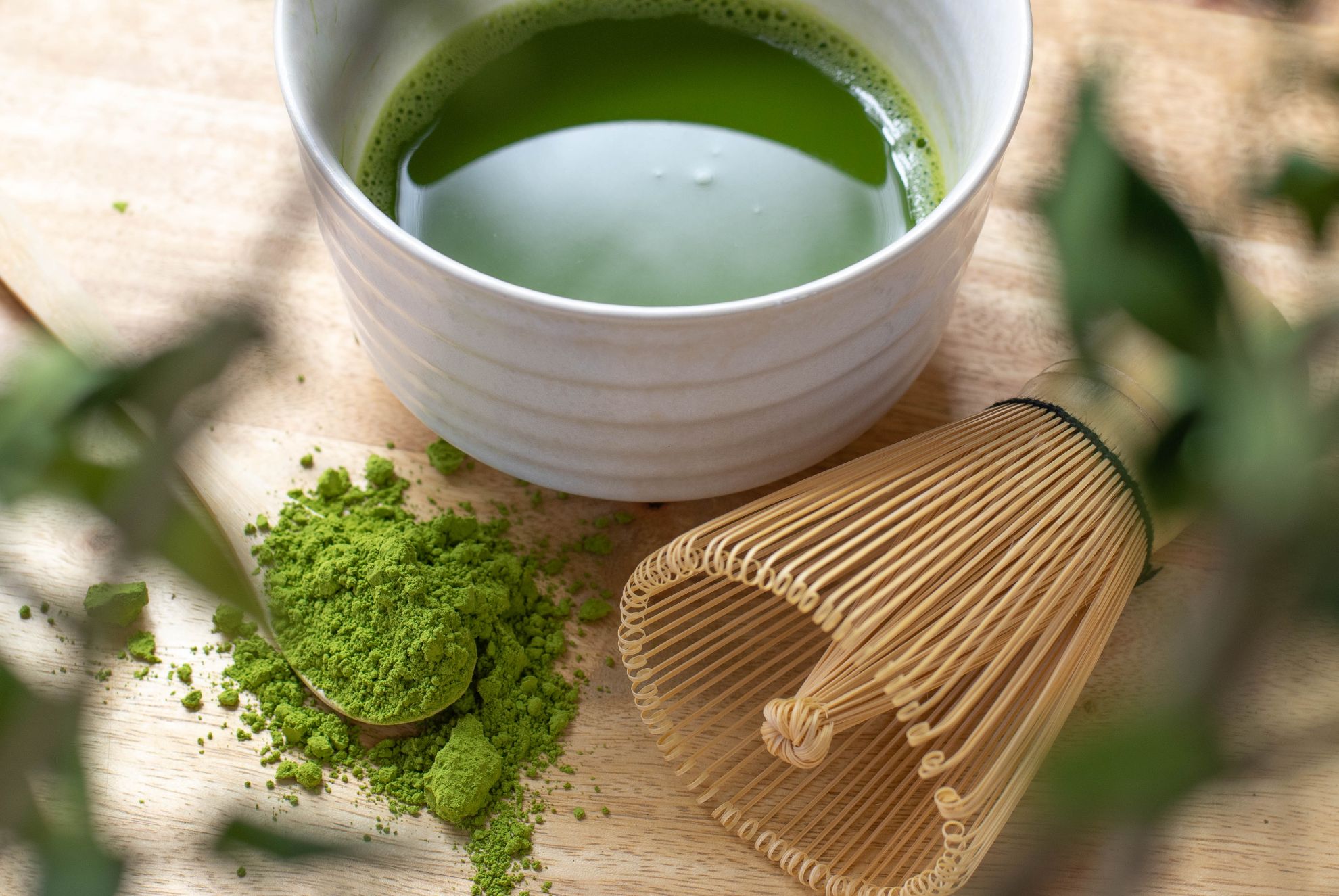
The result is a tea powder with a strong umami, natural sweetness, and the signature, vibrant green color. Japanese matcha is brewed with pure water – no milk nor sugar – to let it showcase all the natural goodness.
Commercial producers replace this slow process with fast electric grinders.However, this makes the resulting powder lose color, aroma, and even some of the taste. Those who are just about to set on a journey to the world of Japanese customs can try Japan Matcha Uguisu BIO from Shizuoky. It's a bit on the expensive end, but believe us when we tell you: it's more than worth the price.
Chinese matcha: Great value for your money
Chinese matcha is made with more modern technologies, making the production faster and more efficient.The taste is often on the earthy side , with the occasional mild astringency, but that doesn't make it a bad product. For everyday lattes, smoothies, or cooking, Chinese matcha is a great and reasonably priced choice.Matcha China BIO from Manu Tea which you can find in our online store, is robust, full, and goes perfectly with a morning smoothie.
Ceremonial matcha is brewed with water around 70 to 80 °C and should be whisked with a bamboo tool called chasen until it forms a thick foam. Cooking matcha is better suited with other ingredients and you don't have to spend a fortune to get it. For baking, granola, or green pancakes, we heartily recommend Matcha China Cooking from Manu Tea.
Why is premium matcha so expensive? Here are some reasons
The price is more than just marketing. Each individual bag of high-quality Japanese matcha is packed with real, unavoidable costs.Manual work is a large part of the final price. . Imagine it: manual harvest of the first spring leaves, rigorous hand-selection process, even the slow grinding in the stone mills.
The best batches of matcha are always from the first spring picking. But its production is extremely limited.. In Japanese regions such as Kagoshima or Shizuoka, tea cultivation is inherited from generation to generation and farmers refuse to compromise quality for the sake of production.
Kirishima Matcha Master Grand Reserve BIO originates in the Kirishima area on the Kyushu Island. Here, the Nishi family cultivates tea plants in organic conditions using 60 hectares of volcanic soil. The owner himself walks through his gardens each morning and the plants are shaded for more than 20 days. They also use the traditional granite mill called chausu.

The result is a matcha with pronounced umami, natural sweetness, and without any astringency.Japan Matcha Hana BIO Top Selection, also from the Kagoshima Prefecture, presents a harmonious, autumnal flavor with a mildly grassy finish that's perfect for both latte and traditional preparation..
Five ways to identify bad matcha
You don't have to be an expert to notice the difference. You just need to know what to focus on. The fastest way to tell is to take a look at the color.Good matcha is a bright, almost neon emerald. Cheap or stale matcha looks yellowish or olive green
Next, the texture of matcha is that of a very fine powder. Each particle is only around 5 to 10 micrometers. Coarser or sand-like sensation can give away fast or reckless grinding. The aroma and taste of high-quality matcha is grassy, mildly sweet, and creamy. Astringency should be left to a minimum, if there is any at all.
If your matcha tastes distinctly astringent and becomes bitter after the first sip, it's either cooking matcha, or it was ruined during preparation with too-hot water. Another reliable indicator is the foam.Matcha can be whisked up to a thick, soft foam that can hold its shape. Cheaper varieties have less foam that quickly collapses.
| Japanese Matcha | Chinese Matcha | |
| Color | Bright emerald | Yellowish brown |
| Taste | Mild, sweetish, umami | Stronger, more astringent |
| Best with | Pure water, traditional tea ceremony | Smoothies, baking, cooking |
| Price | VHigh | More accessible |
| Texture | Silky, soft | More coarse |
| Foam | Creamy, thick | Low to no |
Freshness is a crucial quality indicator for matcha, even more than for other teas. After opening, matcha tends to oxidize very quickly and should be consumed within two months.High-quality matcha always comes in hermetically sealed containers that protect it from light, humidity, and foreign odors.
What most people don't know about matcha
In Japan, people have been drinking and perfecting matcha for over 800 years. Samurai warriors brewed it before battle for its ability to make you calm, sharpen your focus, and reduce tension. This effect is credited to L-theanine, an amino acid that's unusually high in matcha thanks to the pre-harvest shading.
What's more, L-theanine slows down the breakdown of caffeine in the body, so the provided energy lasts much longer. When drinking matcha, you also consume the whole leaf, unlike in regular teas. Instead of being brewed and discarded along with a portion of vitamins, minerals, and antioxidantsmatcha lets you drink the entire thing and provides the full spectrum of benefits that regular teas simply cannot.
This means your body takes in much more antioxidants than with ordinary, loose-leaf green tea. One stone mill can grind only 30 to 40 grams of matcha per hour. This makes one kilogram of matcha worth roughly 25 hours of slow manual grinding. . Once you know this, the price of ceremonial matcha starts to make a lot more sense.
And the last interesting fact we've prepared for you is about the word 'umami'. It's often associated with matcha, but did you know it describes a fifth taste aside from sweet, savory, sour, and bitter?It's that almost indescribable fullness and depththat's responsible for a lasting aftertaste. And it's exactly the thing that supermarket matcha lacks
Matcha has long ceased being the privilege of Japanese monks and tea ceremonies. Nowadays, you can even find it flavored with vanilla, ginger, caramel, or cinnamon, in lattes, smoothies, desserts, or ice cream. Those, who don't want to dive into pure matcha right away,can try flavored varieties. It's the easiest way into the world of matcha
And once you start the journey, you're not gonna want to stop.
